AI Song Maker App: Turn Your Voice & Lyrics into Original AI Music
AI Song Maker Apps: Create AI Music, Songs and Covers with Your Voice
Creating music is no longer limited to professional singers, musicians, or people with expensive recording equipment. With the growth of Artificial Intelligence, anyone can experiment with lyrics, vocals, melodies, and different music styles using AI Song Maker Apps and online tools.
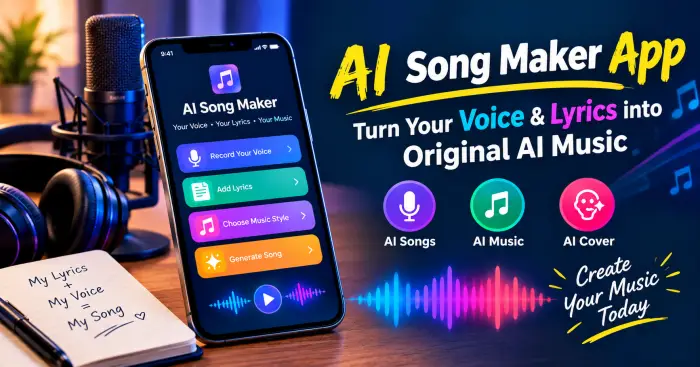
Whether you have written your own lyrics, want to turn an idea into a complete song, or simply want to experiment with your voice, AI music tools can make the process much easier. Many of these platforms can generate music from text prompts, lyrics, or other inputs within a short time.
Below are five well-known AI music creation platforms that are worth exploring.
What Is an AI Song Maker App?
An AI Song Maker App is an application or AI-based platform that uses Artificial Intelligence to help users create songs and music. Depending on the platform, you may be able to provide lyrics, describe the type of song you want, select a music style, or use voice-related features.
Instead of manually creating every musical element, AI can generate different parts of a song based on the instructions you provide.
The available features can vary considerably from one platform to another. Some focus mainly on complete song generation, while others provide additional tools for voice transformation, music production, or creative audio generation.
Top 5 AI Song Maker Apps and Tools
There are many AI music platforms available today, but the following five are among the better-known options for people interested in experimenting with AI-generated songs and music.
1. Suno
Suno is one of the most widely known AI music creation platforms. It allows users to generate songs from text-based instructions and lyrics.
You can describe the type of song you want and provide your own lyrics or creative idea. The platform can then generate music around that concept, including vocals and instrumental elements.
Suno can be useful for people who want to experiment with different genres, moods, and songwriting ideas without having traditional music-production skills.
It can also be useful for creating ideas for YouTube videos, short-form content, personal music projects, and other creative experiments. However, users should check the current plan, licensing, and usage conditions before using generated music commercially.
2. Musicfy
Musicfy is another AI-focused platform that offers tools for experimenting with AI-generated music and voice-related content.
Depending on the available features, users can explore different ways of creating or transforming vocals and music. This can make it useful for creators who want to experiment with their voice or develop new musical ideas.
Musicfy may be particularly interesting for content creators who want to explore AI-assisted vocals and music rather than relying entirely on traditional recording and production methods.
As with any AI music platform, the available features and licensing terms can change over time, so users should review the current terms before publishing or monetizing their content.
3. Donna AI Song & Music Maker
Donna AI Song & Music Maker is designed for users who want to experiment with AI-powered song and music creation from a mobile device.
The concept is particularly useful for people who want to create music without using complicated professional music-production software. Depending on the available features, users can work with song ideas, lyrics, and different musical styles.
For casual users and beginners, a mobile-focused AI music app can be a convenient way to explore songwriting and music creation.
Before using generated songs for commercial purposes, it is important to check the app's current licensing and usage rules.
4. Udio
Udio is an AI music generation platform that allows users to create music using text prompts and creative descriptions.
Users can describe the type of music or song they want and experiment with different genres, styles, moods, and concepts. This makes it useful for people who want to turn a simple musical idea into an AI-generated track.
Udio can also be useful for experimenting with songwriting concepts and developing music ideas without having to produce every musical element manually.
However, AI-generated music can be subject to platform-specific restrictions. Always review the latest Terms of Service and licensing information before using the generated content commercially.
5. Soundful
Soundful is an AI-powered music creation platform focused on helping users generate music and tracks using Artificial Intelligence.
It can be useful for creators who need background music or want to experiment with AI-generated tracks for different types of digital content.
Depending on the plan and available features, users may be able to create music suited to different moods, styles, and content requirements.
If you plan to use AI-generated tracks in monetized videos, advertisements, business projects, or other commercial content, check the applicable license before publishing.
Can You Create a Song Using Your Own Voice?
Some AI music platforms offer voice-related features that allow users to experiment with their own recorded voice or AI-assisted vocal generation.
The exact process depends on the platform. You may need to provide a voice recording, select a suitable feature, or use an AI voice model supported by the service.
This can be interesting for creators who want to combine their own lyrics and vocal identity with AI-generated music.
However, voice-related features require additional privacy considerations. Before uploading a voice recording, check the platform's Privacy Policy and understand how uploaded audio may be processed or stored.
What About AI Cover Songs?
AI technology can also be used for different types of AI Cover experiments. Some tools allow users to transform vocals or experiment with different vocal styles.
However, AI Cover content can involve copyright and voice-rights issues. Using another person's voice, a famous singer's vocal identity, or copyrighted songs without appropriate permission can create legal or platform-related problems.
Therefore, do not assume that an AI-generated cover is automatically free to publish or monetize.
What Can You Create With AI Music?
AI-generated music can be used for many creative projects, depending on the applicable license and usage rights.
For example, creators may use AI music for:
- YouTube videos
- Instagram Reels
- Facebook videos
- Short-form videos
- Podcasts
- Background music
- Personal music projects
- Creative audio content
- Video introductions and outros
The exact commercial rights depend on the platform, subscription plan, and license associated with the generated content.
How to Use an AI Song Maker App
Although the process differs between platforms, the general workflow is fairly simple.
First, choose an AI Song Maker platform based on the type of music you want to create. Then enter your lyrics, describe your song idea, or provide another supported input.
Depending on the platform, you may be able to select a genre, mood, vocal style, or other musical characteristics. After entering the required information, generate the song and listen to the result.
If the first version does not match your expectations, try changing the lyrics, prompt, genre, or other settings and generate another version.
Tips for Getting Better AI Music Results
The quality of your instructions can have a significant effect on the generated result.
Try to describe your desired song clearly. Mention the general mood, genre, tempo, vocal style, and theme when those options are supported.
If you are using your own lyrics, organize them clearly and make sure the structure matches the type of song you want to create.
You can also generate multiple versions of the same idea and compare the results. Small changes to your prompt or lyrics can sometimes produce noticeably different music.
What Should You Check Before Downloading an AI Music App?
Before downloading or using any AI Song Maker App, take a few minutes to check its important policies and features.
Look at where the app comes from, what permissions it requests, what type of data it collects, and how uploaded audio or other content is handled.
You should also check whether the app provides a Free or Paid plan, what features are included in each plan, and whether Commercial Usage is permitted.
Most importantly, check the current Terms of Service, Privacy Policy, Copyright information, and License conditions.
Is AI-Generated Music Always Free to Use?
No. AI-generated music is not automatically free for every type of use.
Different AI music platforms can have different licensing systems. A track generated under a Free plan may have different usage rights from one generated under a Paid plan.
If you want to use AI music for YouTube Monetization, advertising, business projects, client work, or other commercial purposes, check the specific license that applies to your account and the generated content.
Do not rely only on the fact that you created the track using an AI tool. The platform's terms determine what uses are permitted.
Copyright and AI Music
Copyright is one of the most important things to consider when working with AI-generated music.
Avoid uploading or reproducing copyrighted lyrics, music, recordings, or other material unless you have the necessary rights or permission.
You should also be careful when creating AI Cover songs or using voices that resemble identifiable singers or other individuals.
If you plan to publish or monetize AI-generated music, review the applicable copyright rules, platform policies, and AI service license before using the content publicly.
Final Thoughts
AI Song Maker Apps are making music creation more accessible to beginners and content creators. You do not necessarily need professional recording equipment or advanced music-production knowledge to start experimenting with songs and AI-generated music.
Platforms such as Suno, Musicfy, Donna AI Song & Music Maker, Udio, and Soundful offer different approaches to AI-assisted music creation. Their features, pricing, licensing, and usage policies can change, so always check the latest official information before relying on a particular feature.
If you are interested in AI music, start with simple ideas, experiment with different prompts and styles, and understand the usage rights before publishing your creations.
Disclaimer
This article is provided for informational, educational, and awareness purposes only. We are not the owner, developer, operator, or representative of any app or platform mentioned in this article. We do not have any ownership, partnership, sponsorship, endorsement, or direct commercial relationship with the mentioned apps or their developers, and we do not conduct any direct financial transactions with them.
Features, pricing, availability, licensing terms, Privacy Policies, and Commercial Usage rules may change at any time. Readers should verify the latest information from the respective official sources before using any app or platform.
Before publishing, distributing, or monetizing AI-generated music, users should independently check applicable Copyright, Licensing, Voice Rights, and Platform Usage Rules. The responsibility for the lawful use of generated content rests with the user.